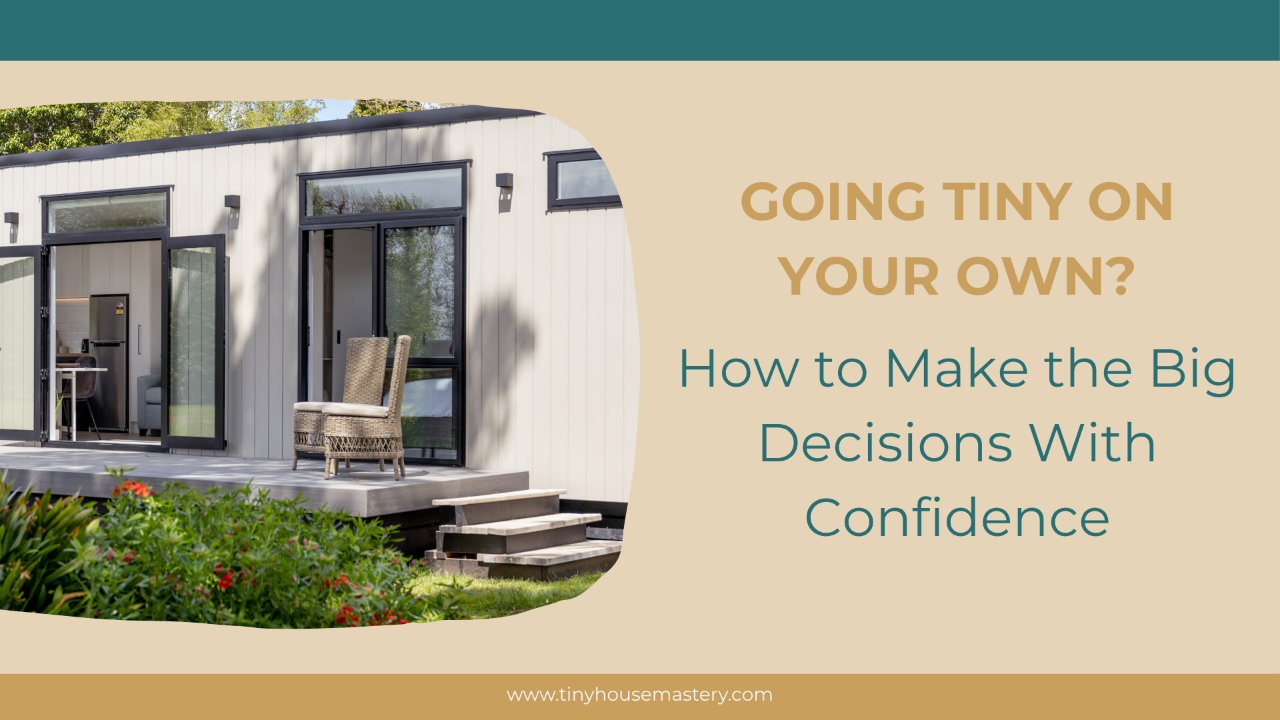
Going Tiny on Your Own? How to Make the Big Decisions With Confidence
There’s something I’ve noticed in my client work lately.
Quite a few of the people I’m helping are navigating their tiny living journey largely on their own.
Some are single. Some are creating a home after a major life change. Some are trying to get onto the property ladder in a way that feels achievable.
And while their projects are all different, there’s something many of them have in common.
They don’t necessarily need more information.
They need someone in their corner.
Someone who understands what they’re ultimately trying to achieve and can help them make sense of all the information, opinions and decisions that come with creating a home.
Because going tiny might look simple from the outside.
Find a tiny house. Find somewhere to put it. Move in.
Unfortunately, there can be quite a bit more to it than that.
When you're making all the decisions yourself
A tiny home project can involve decisions around land, council, services, access, finance, builders, budgets, legal pathways and the home itself.
You might have a builder giving you advice about the build.
Council explaining their requirements.
A finance company telling you what they’ll lend.
A planner looking at the planning rules.
An engineer looking at the site.
Each person understands their piece.
But ultimately, you’re the one who has to make the decisions.
And when you're doing that on your own, there isn't necessarily another person sitting beside you at 9pm saying:
Hang on. Why are we paying for that now?
Did Council actually confirm that?
Does that quote include the foundations?
Are we sure this land works?
What happens if this costs another $30,000?
Is this still getting us closer to what we wanted in the first place?
That can be a lot to carry.
Being single isn't the problem
I want to be clear about this.
Being single doesn't mean you're somehow less capable of managing a tiny home project.
And being a couple certainly doesn't guarantee you'll make better decisions!
The difference is simply that when you're doing it alone, you often don't have a built-in second set of eyes.
Every quote.
Every risk.
Every trade-off.
Every confusing council email.
Every exciting idea that suddenly appears on Pinterest at 10pm.
It all comes back to you.
And sometimes you don't need somebody to make those decisions for you.
You just need someone who can look at the whole picture and work through them with you.
More information isn't always the answer
There is no shortage of tiny home information.
We've got Google, Facebook groups, YouTube, council websites, builders, expos and friends who know someone who put a tiny house on their cousin's property five years ago and apparently “Council was fine with it.”
The difficulty is working out what actually applies to you.
Your property is different.
Your budget is different.
Your family is different.
Your appetite for risk is different.
And the life you're trying to create is different.
That's why one of the first things I want to understand when I work with somebody isn't which tiny house they like.
It's:
What are you actually trying to achieve?
Because sometimes the building somebody thinks they need isn't necessarily the best solution to the problem they're trying to solve.
The decisions I wouldn't rush
When you're excited about finally creating your own home, it's tempting to do something that feels like progress.
Find the builder.
Choose the floor plan.
Buy the section.
Pay for drawings.
Put down a deposit.
Order the house.
But progress isn't simply making decisions.
It's making the right decisions in the right order.
Before making a significant commitment, I'd want to understand three things:
What are you actually trying to create?
What needs to be confirmed before you spend money on it?
What's the next decision you actually need to make?
Not the next ten.
Just the next one.
You don't need to have your whole project figured out.
You need enough clarity to make the next good decision.
Sometimes you need someone in your corner
Home ownership is a big deal.
For many of the people I work with, this isn't an investment they're casually adding to a property portfolio.
It might represent most of their savings.
Their retirement plan.
Their chance to get out of renting.
Their opportunity to live closer to family.
Their security after a relationship ends.
Or simply the first home that genuinely belongs to them.
There's an emotional weight to those decisions as well as a financial one.
Having someone in your corner doesn't mean handing over control.
You should still be making the decisions.
Sometimes you just need someone who can say:
Okay. There are six things flying around here. Which one actually needs solving first?
Someone who can spot a question you haven't thought to ask.
Someone who can help you compare the trade-offs between two options.
Someone who can say, Don't spend money on that yet. Let's confirm this first.
That's the part of this work I've come to really value.
And this isn't just about people going tiny alone
Interestingly, sometimes having more people involved creates even more decisions.
Granny flats are a perfect example.
A family might start with:
“We'd like to build a granny flat for Mum.”
It sounds like a building project.
But before choosing the building, there are much bigger conversations worth having.
What does Mum actually want?
How much independence does she want?
How close does she want to be to the main house?
Whose money will pay for it?
Who will own what?
What happens if the property is eventually sold?
What might Mum need in ten years?
What does everyone expect this arrangement to look like?
Then you add the property, budget, council pathway, services, access and the building itself.
Suddenly you realise:
It's a family, property, financial and lifestyle decision that happens to involve a building.
And despite several family members being involved, there's often still one person carrying most of the project.
They're researching.
Talking to Council.
Meeting builders.
Getting quotes.
Keeping Mum informed.
Talking to siblings.
And wondering whether they've missed something important.
They need someone in their corner too.
The building isn't really the outcome
Whether you're creating a tiny home for yourself or a granny flat for somebody you love, this is the question I keep coming back to:
What are you actually trying to create?
Security?
Independence?
Less debt?
A way out of renting?
Being closer to family?
Rental income?
A simpler retirement?
Because the building isn't really the outcome.
It's what the building makes possible.
Once you understand that, you can start testing the different ways to achieve it.
Sometimes the answer will be a Tiny House on Wheels.
Sometimes a granny flat.
Sometimes buying land.
Sometimes leasing it.
And sometimes the best decision you make is realising you have another option.
You don't have to carry the whole journey yourself
This is one of the reasons I created Tiny Living Pathway™.
It's for people who don't necessarily want someone to take over their project.
They're still happy to research, make phone calls, talk to Council and make their own decisions.
They'd just really value having someone in their corner while they do it.
Someone who understands the bigger picture.
Someone to help work out what needs checking, what can wait and what decision comes next.
Because making a big housing decision on your own doesn't mean you have to know everything.
And it doesn't mean you have to figure everything out by yourself.
Sometimes you simply need enough clarity, and the right support around you, to make the next good decision.
Then the next one.
>> Find out more about Tiny Living Pathway™ here
Stay connected with news and updates!
Join our mailing list to receive the latest news and updates from our team.
Don't worry, your information will not be shared.
We hate SPAM. We will never sell your information, for any reason.